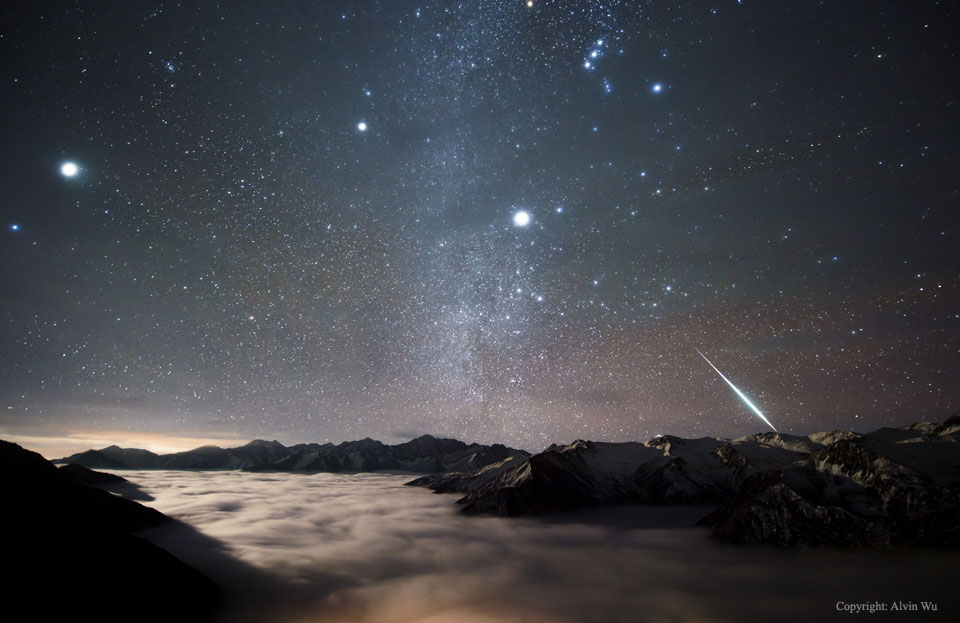
Friday night I went outside and closely observed the Cygnus constellation, looking for similarities between the stars in the night sky and the stars in the magnitude charts. Also, I made an extra effort and went out behind my house to see the other half of the sky, I was able to identify Orion from there.
Second Week
I was trying to distinguish the summer triangle and its constellations, then I realized that I was looking at Casseopeia, recognized by the Worm asterism. Upon realizing I was not looking at the summer sky, I became slightly disoriented due to my lack of fall sky observation experience. I finally found my bearings with Cepheus, and from there was able to identify Pegasus (by the Great Square), Andromeda (also by the Great Square), and Perseus.
Objects Viewed: Cepheus, Casseopeia, Pegasus, Perseus, Great Square of Pegasus, Andromeda.
Third Week
All objects were viewed with the naked eye.
Fourth Week
This week I really tried to see everything. The sky was decent enough to view.
Constellations viewed: Pisces Austrinus, Aquarius, Fomalhaut, and Pisces, Casseiopeia, Cepheus, Perseus, Summer Triangle, Altair, Lyra, Cygnus and the Northern Cross, Delphinus, Sagitta, and Equuleus, Pegasus and the Great Square of Pegasus and Andromeda.
Fifth Week
I was able to view a few bright stars, but I was not able to get my bearings because clouds rolled in. I was interested, though, by how far away the clouds seemed to be, which added to the feeling of the atmosphere being either far away or nonexistent. The moon was extremely bright, and I was able to distinguish many of its features. I also saw many of the previous constellation. Ursa Minor, Cassiopeia, Cepheus, and Pisces.
Sixth Week
EP. 349: Mercury 7
Before the Gemini program was the Mercury program. How did they choose them? The Mercury seven were test pilots. They wanted experienced test pilots. Requirements, less than 180 LB, 5"11, and experienced, also under the age of 40 and a bachelors degree. They got many applicants, and looked into their backgrounds. They brought them in 2 groups and the first group was so good that they just took them in. Then they "tortured" them, in other words to prepare them for space. Many of them were weeded out. started out with 69 and ended out with 7. The people were: grysin, cooper, slackem, shepard, carpenter, and shera, and john glenn. They were like family afterwards. NASA was very scared for the people, what would happen when they went into space. Intresting story, that this one guys pissed in his suit and went into space. Many of these men flew again in the Apollo missions.
Seventh Week
EP. 336: Units of Measure
The basic measurement for distance is a meter. It was intially defined by the distance between the Earth's equator to the North Pole. 1 ten million the distance that is. Now it is the path of light traveled. Time is the seconds. Seconds are defined of the period of the radiation of the 2 hyperfile levels of the cesium levels 233. Very confusing way we get seconds. In a cesium atom there is a hyperfile transition that is an energy, it emits alot of period and that is a second. With thwaw two calculations, we can translate this information to aliens to tell them how we measure stuff. The last measurement is gram/kilogram. The kilogram is based of a thing. It is locked away in meteorlogical facilities. Initailly 1 cubic cm of water was 1 gram. However this did not add up to 1 Kg, 1000 ml of water equaled .000005 off.
Eighth Week
This week, because of Mr. Percival, I was able to view the iridium flare on Wednesday. This was soo bright compared to the other stars it was almost hard to miss. The other stars I viewed this week are Pisces, Ursa Minor, Cassiopeia, Mars, Andromeda, and the Pegasus. In these constalations I was able to see the great square of Pegasus.
I was able to view a few bright stars, but I was not able to get my bearings because clouds rolled in. I was interested, though, by how far away the clouds seemed to be, which added to the feeling of the atmosphere being either far away or nonexistent. The moon was extremely bright, and I was able to distinguish many of its features. I also saw many of the previous constellation. Ursa Minor, Cassiopeia, Cepheus, and Pisces.
Sixth Week
EP. 349: Mercury 7
Before the Gemini program was the Mercury program. How did they choose them? The Mercury seven were test pilots. They wanted experienced test pilots. Requirements, less than 180 LB, 5"11, and experienced, also under the age of 40 and a bachelors degree. They got many applicants, and looked into their backgrounds. They brought them in 2 groups and the first group was so good that they just took them in. Then they "tortured" them, in other words to prepare them for space. Many of them were weeded out. started out with 69 and ended out with 7. The people were: grysin, cooper, slackem, shepard, carpenter, and shera, and john glenn. They were like family afterwards. NASA was very scared for the people, what would happen when they went into space. Intresting story, that this one guys pissed in his suit and went into space. Many of these men flew again in the Apollo missions.
Seventh Week
EP. 336: Units of Measure
The basic measurement for distance is a meter. It was intially defined by the distance between the Earth's equator to the North Pole. 1 ten million the distance that is. Now it is the path of light traveled. Time is the seconds. Seconds are defined of the period of the radiation of the 2 hyperfile levels of the cesium levels 233. Very confusing way we get seconds. In a cesium atom there is a hyperfile transition that is an energy, it emits alot of period and that is a second. With thwaw two calculations, we can translate this information to aliens to tell them how we measure stuff. The last measurement is gram/kilogram. The kilogram is based of a thing. It is locked away in meteorlogical facilities. Initailly 1 cubic cm of water was 1 gram. However this did not add up to 1 Kg, 1000 ml of water equaled .000005 off.
Eighth Week
This week, because of Mr. Percival, I was able to view the iridium flare on Wednesday. This was soo bright compared to the other stars it was almost hard to miss. The other stars I viewed this week are Pisces, Ursa Minor, Cassiopeia, Mars, Andromeda, and the Pegasus. In these constalations I was able to see the great square of Pegasus.